
The Hidden Cost of Staying You
On discomfort, better questions, and why growth starts where routines end.
Henning Voss
2/3/20266 min read
I didn't like the RV.
I didn't like its size, the blind spots, the way it turned every tight corner into a small act of faith. I didn't like the unspoken assumption that if something broke, I would have to fix it. I'm not handy. I also don't like campgrounds. Or holiday parks. I'm a boutique-hotel person. Crisp sheets, cool designs, and the feeling that someone else has thought things through.
And yet, last year, we spent real money on an experience instead of comfort. Three weeks. New Zealand. North and South Island. An RV large enough to make me question my life choices, ferried across the Cook Strait like a kind of confession that this trip would not be "on brand."
There's a sentence we all reach for when we want to quietly opt out: "That's not really me."
Not a dramatic refusal. Just a preference. Calm. Reasonable. Final.
What I didn't expect is how expensive that sentence can become.
When Knowing Yourself Becomes a Cage
We're taught to know ourselves. To curate our lives around what suits us. It sounds like wisdom. Over time, though, this hardens into a subtle identity contract: this is who I am, therefore this is what I do.
I'm not the kind of person who stays on campgrounds. Who drives oversized vehicles. Who looks clumsy in public. Who doesn't know how things work. Who feels incompetent. That last one matters more than we like to admit (especially to me).
Because what often masquerades as taste or good sense is really something else, an effort to protect our self-image. To avoid situations where we might look unsure, slow, exposed. Where other people might notice and worst of all ‘judge’.
The problem with that strategy is not that it's cowardly. It's that it shrinks your world.
The longer you optimize for consistency, the smaller your world gets. Fewer first-times. Fewer surprises. Fewer moments that require you to recalibrate who you think you are.
That's the hidden cost of staying you. The cost isn’t obvious. It shows up slowly, in the things that never happen.
The Water Hose Moment
Our third morning at another holiday park, we needed to refill the freshwater tank. Simple enough. There was a tap. We had a hose. What we didn't have was the adapter to connect them.
We tried anyway. I held the hose against the faucet while water sprayed everywhere, on my shirt, my shoes, the gravel around us. My daughters watched from the RV window, laughing. Another family walked by. I could feel their glance and that quiet assessment: Amateur.
The thing is, I was right. I was an amateur. And standing there, trying to make a hose fit through sheer willpower, I realized something: I spend an enormous amount of energy avoiding exactly this feeling.
Looking incompetent. Being the person who doesn't know. Having strangers witness my learning curve. That morning cost me something I usually pay to avoid: embarrassment.
And the world didn't end.
Becoming Fluent in What You Fear
New Zealand, to be fair, is probably the easiest place on earth to do an RV holiday. Wide roads. Space everywhere. Motorhome parks that feel purpose-built for mild anxiety and large vehicles. Every time I felt overwhelmed navigating mountain roads, I reminded myself that people do this on the Amalfi Coast. Voluntarily. With Italian traffic.
Still, fear doesn't respond to logic.
We invented a family lottery for who had to change the toilet cassette. It was objectively hilarious and subjectively horrifying. My kids rigged the draw. The family jointly decided that lottery or not, I was doing it first. There is nothing like confronting a literal container of your own waste to dissolve illusions of dignity.
But here's what happened: within a week, all of it became second nature. The cassette. The greywater. The freshwater refills. Setting up the awning. Converting the dinette into beds. We moved through these tasks without thinking, the same way you eventually stop overthinking parallel parking or using chopsticks.
I didn't become outdoorsy. I didn't suddenly enjoy campgrounds. But my tolerance for incompetence increased. And with it, my confidence.
Not the performative kind. The quieter kind that comes from discovering you can survive situations where you don't look impressive.
Jumping Off Mountains
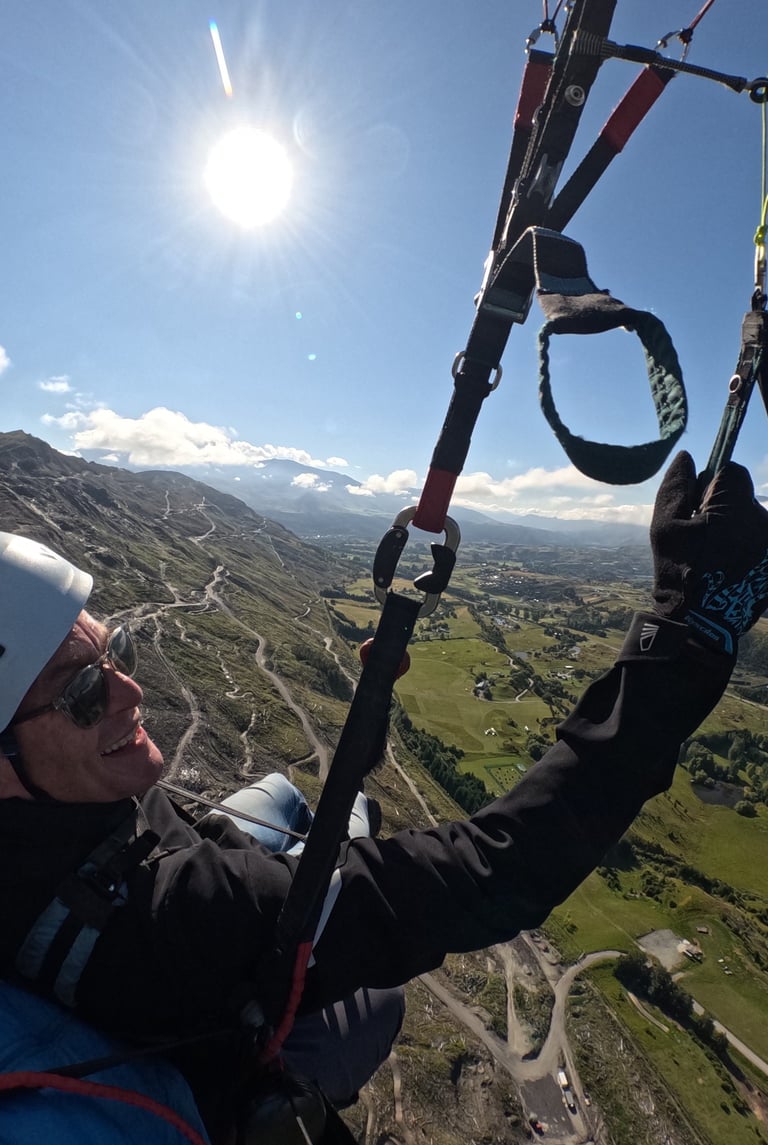
Midway through the trip, in Queenstown, I suggested we go paragliding. I'm not entirely sure why. I'm not afraid of heights exactly, but I'm also not the person who seeks them out for recreation. Maybe it was the momentum of planning the trip. Maybe I wanted to see if I could keep choosing discomfort. Running off a mountain attached to fabric felt less like adventure and more like a test of whether I trusted physics and my tandem paragliding teacher.
My daughters were game. So we went. And for fifteen minutes, we soared over Queenstown in silence. Just wind and the strange, weightless feeling of being held by air.
Afterwards, standing back on solid ground, we were saying that we will remember this forever. Not because it was extreme or because we conquered something. Because we chose the version of the trip where we didn't stay comfortable. Where we didn't optimize for being ourselves.
That's when I started to understand: discomfort isn't the cost. It's the point.
The Lie of Jackpot Thinking
Adam Mastroianni has a metaphor I keep returning to: being stuck is like standing knee-deep in a bog. Not trapped by catastrophe, but by sameness. No clear path out, just more of the same in every direction.
What's important is his reframing: stuckness isn't laziness. It's often over-coherence. The desire to stay consistent, reasonable, respectable.
Two patterns show up everywhere. The mediocrity trap, situations that are bad-but-not-bad-enough. They don't create urgency, just low-grade dissatisfaction. You don't flee. You orbit. Years can go by. I see this with friends who dislike their jobs but can't bring themselves to leave. They prefer to stay moderately unhappy.
And then there's jackpot thinking. Refusing to move until an option appears with only upsides. No awkwardness. No loss of status. No discomfort. This option, mysteriously, never arrives.
The bog isn't drama. It's politeness. It's "I should be grateful." It's a calendar that keeps you busy and unchanged.
When Convenience Becomes Avoidance
A small confession: recently, ChatGPT was down for a few hours, and I panicked.
Not because I couldn't work. I could. But because I realized how dependent I'd become. Drafting emails in English (my second language) structuring thoughts, finding the right tone. The tool had absorbed a layer of effort I used to do myself.
At first, that felt like leverage. And often it is. But I also felt exposed. Like a fraud. Like I'd been getting away with something and suddenly I was caught.
There's a line where convenience quietly turns into avoidance. Where friction, the kind that sharpens thinking, gets outsourced. The danger isn't that AI makes us lazy. It's that it makes us smooth.
And smoothness is not the same as growth. Some forms of struggle are not inefficiencies. They're training.
Why Discomfort Makes Life Feel Longer
There's an idea I first encountered in the book Moonwalking with Einstein: novelty stretches time, routine compresses it. Objectively, days pass at the same rate. Subjectively, they don't.
Routine days blur. Novel days leave markers.
You feel this intuitively. A week of familiar work disappears. A week of travel, challenge, or newness feels dense when you look back. It’s also why time feels so different as a child. When you’re young, waiting for a birthday or Christmas feels endless. As an adult, you look up and it’s suddenly the end of March. The difference isn’t the calendar, it’s memory. Children live in a stream of first experiences. They accumulate. Adults live in routines. Days collapse into each other.
This reframes discomfort in an unexpected way, not as self-improvement, but as anti-regret. Comfort makes life efficient. Discomfort makes it memorable. And memory density, over decades, might be one of the truest measures of a life well lived.
What Changed (And What Didn't)
I came back from New Zealand still preferring boutique hotels and not enjoying campgrounds. I still feel more than a flash of self-consciousness when I don't know what I'm doing.
But something shifted.
I decided that jumping out of comfort zones, even if some people might regard the RV thing as peanuts, is worth doing. Not for transformation. Not for bragging rights. Just because staying in our lane had quietly become more expensive than we realized.
We're planning a trip to Japan now. Still plotting what our adventure there will look like. Still figuring out what discomfort we'll choose this time.
Because here's what the RV taught me: staying exactly who I think I am has a maintenance cost. And if I never pay it upfront, in discomfort, in awkwardness, in moments where I look like I don't know what I'm doing, I pay it later in something worse.
A shrinking world.
So yes, choose comfort where it's wise. Build routines. Use tools. Optimize intelligently.
Just don't let your routines harden into your identity.
The hidden bill always comes due. I'm still learning to pay it willingly. But I'd rather stumble through an adventure I'll remember than glide through a decade I won't.